

Travel


One of the most dramatic French nineteenth century buildings, the Palais Longchamps is Marseille’s temple to water. Fresh water from the Alps first arrived by canal on the 8th July 1847 and saved Marseille from repeated droughts and disease. The Palais Longchamps was built at the main distribution point, a sort of header tank for the city. Its sculptures and architecture look particularly good with the low angle of the winter sunlight and the sky blown clear by a violent, glacial, Mistral wind.

Ratcliffe on Soar coal-fired power station in the Trent Valley was new and modern when I was studying at Nottingham University in the 1970s. It was a major landmark from both the Real Ale pub at Trentlock (where the Erewash Canal meets the River Trent) or when I used to cycle south of the Trent.
Back then, Ratcliffe generated electricity at a relatively low price so it was almost always running and so pushing out clouds from its eight cooling towers, even in summer. I remember being impressed at the huge plume of steam from the cooling towers, indicative of the tremendous amount of electrical energy that was being generated.
We did a visit as part of the Electrical and Electronic Engineering degree course, the engineers at Ratcliffe showed us the (then) state of the art and efficient coal-handling and generating technologies. We would think differently now that coal has been unmasked as a major contributor to climate change.

Journey from Euston railway station in London to Keswick railway station in Cumbria. A dawn departure from Euston with the first stop after crossing the Manchester Ship Canal at Warrington. A freight train (mostly containers from one supermarket) let the express pass at Penrith, where I changed. “Every little helps”.
Unfortunately the last passenger train to and from Keswick railway station departed on Saturday 4th March 1972, so I have missed it by nearly fifty years. It’s now only a bus service from the West Coast main line at Penrith to Keswick.
That’s a journey of about 315 miles, about 505 km; the train is faster and less tiring than driving, and less risky.
The early start meant I had a few hours of daylight to enjoy my garden and the lovely autumn colours.
You see great views from the train that you’ll never see any other way, but the windows have a softening effect on photography and the motion distorts, so I’ve made a montage in the style of postcard rather than feature individual images.

Mobility scooters parked on the Promenade at Eastbourne, East Sussex

High tide at Eastbourne, with the Victorian pier looking like a liner moored at a jetty
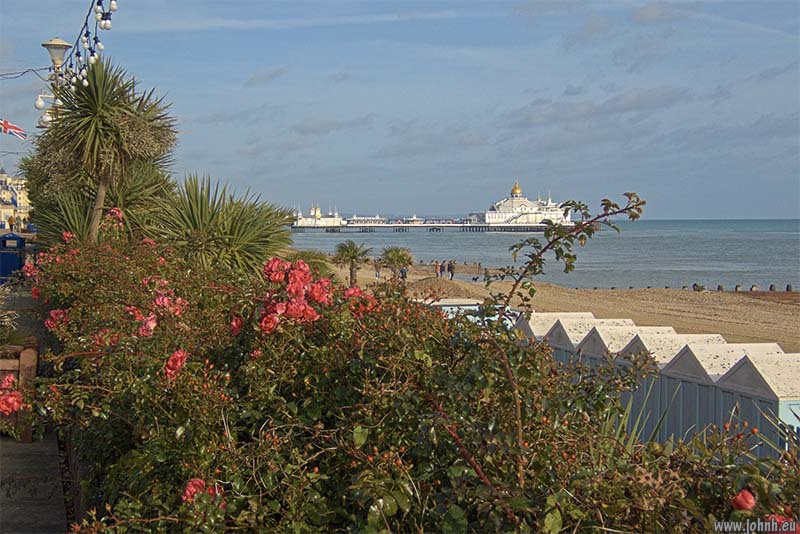
Roses and sub-tropical plants surrounding Eastbourne’s sea front promenade walk
Three views of Eastbourne in East Sussex, guess which one the tourist office would prefer!

Early evening drinks in Cours Julien, Marseille; the stonework glowing in the light of the setting sun.
